Chapter 2 of 9
Multiplier spots
Most tumble slots drop random multiplier symbols onto the reels. Sugar Rush does something more interesting: the board itself keeps score. Here is the rule, what follows from it, and a grid you can click to see it work.
The rule, in the game's words
Whenever a winning symbol explodes it marks its spot on the grid. After the second time a symbol explodes on the same spot a multiplier is added to the spot, starting from x2 and doubling every time one more symbol explodes on top of it up to a maximum of x128. The multiplier applies to all winning combinations that hit on top of it. If more multipliers are involved in the same winning combination, they add to each other.
That is the original Sugar Rush and Sugar Rush Xmas. In Sugar Rush 1000 and Super Scatter the text is the same except for the last number: up to a maximum of x1,024.
The ladder of a single cell
Count explosions on one cell and the rule turns into a simple ladder:
| Explosions on the cell | The cell shows | Sugar Rush, Xmas | 1000, Super Scatter |
|---|---|---|---|
| 1 | marked, no multiplier | ✓ | ✓ |
| 2 | x2 | ✓ | ✓ |
| 3 | x4 | ✓ | ✓ |
| 4 | x8 | ✓ | ✓ |
| 5 | x16 | ✓ | ✓ |
| 6 | x32 | ✓ | ✓ |
| 7 | x64 | ✓ | ✓ |
| 8 | x128 | cap | ✓ |
| 9 | x256 | stays x128 | ✓ |
| 10 | x512 | stays x128 | ✓ |
| 11 | x1,024 | stays x128 | cap |
So a cell needs eight winning explosions to hit x128 and eleven to hit x1,024. That is why the top of the ladder is rare and why it almost only happens in free spins, where cells are not wiped between spins.
Try it: click the cells
Each click is one winning explosion on that cell. Switch between the base game, where the board clears when you press "end the spin", and free spins, where it doesn't. Pick a cap of x128 or x1,024. The full-size version, with clusters, is our spot simulator.
Spots add, they don't multiply
The last sentence of the rule matters most for your wins. When a winning cluster covers several multiplier cells, their values are added together and the total multiplies that cluster's pay once.
Example: five jelly beans win (0.5x the bet). Three of them sit on cells showing x8, x4 and x2; the other two are on unmarked or merely marked cells. The cluster pays 0.5 × (8 + 4 + 2) = 7x the bet. Not 0.5 × 8 × 4 × 2 = 32x.
Here is a real one from our Sugar Rush 1000 Super Free Spins round: five jelly beans on cells adding up to x36 turned a $1.00 cluster into $36.00.
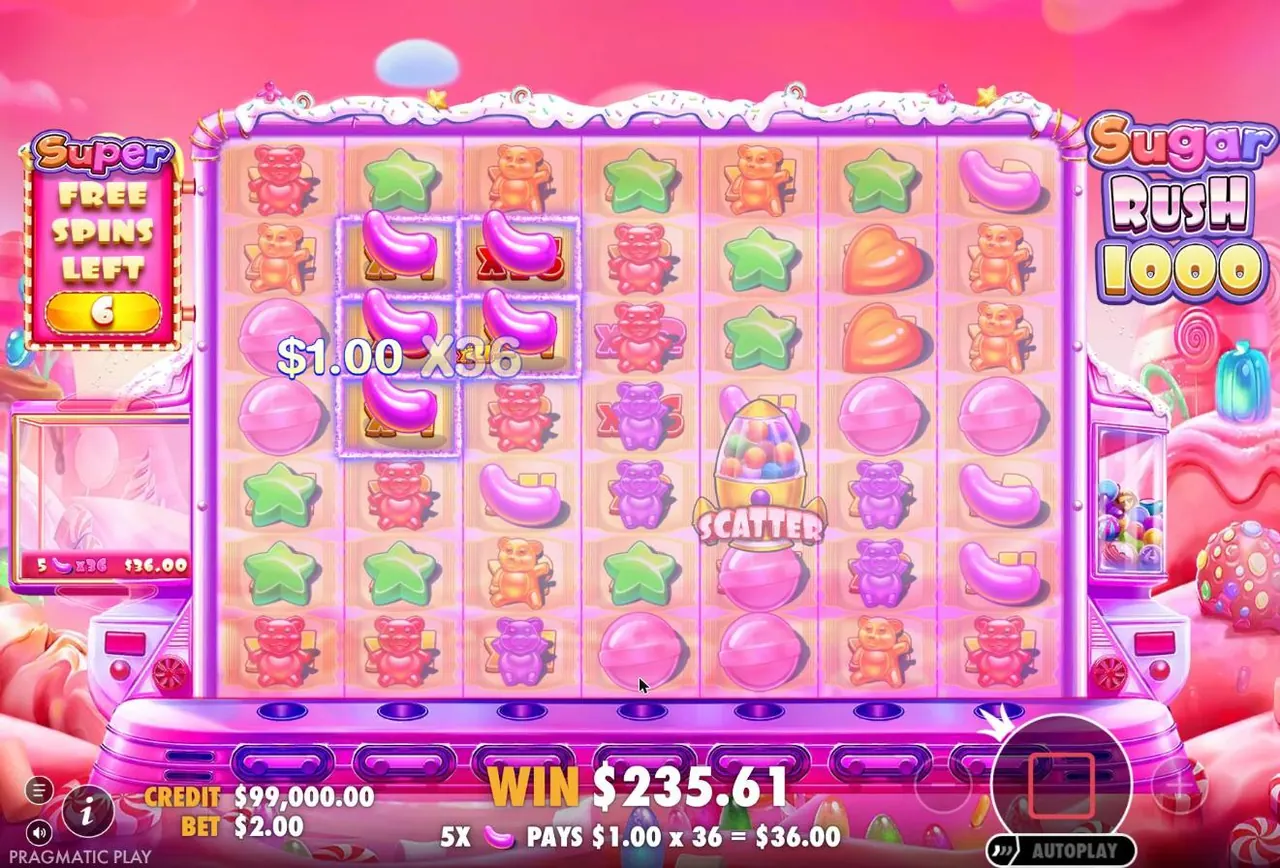
Two consequences follow. A single huge cell under a small cluster can still pay a lot: one x1,024 cell under a five-lollipop cluster is 1,024x. And spreading multipliers widely is almost as good as concentrating them, because any cluster that crosses several of them collects all of them.
And one more: a cell multiplies "all winning combinations that hit on top of it". If two different clusters both cover multiplier cells, each one gets the sum of the cells under it.

Seen how it works? Sugar Rush 1000 is waiting at our partner casino. Real money, 18+. Set your limits first.
When spots reset
- Base game: marks and multipliers last only until the end of the tumble chain. When a refill produces no new win, the board is cleared and the next spin starts clean.
- Free spins: marks and multipliers stay until the round ends, and every explosion keeps doubling them. A retrigger keeps them too.
- Super Free Spins (1000 and Super Scatter, bought for 500x): the round starts with x2 already on all 49 cells, so the very first explosion on any cell takes it to x4.
- Super Spins (Super Scatter only): Super Spin 1 starts random cells of each base spin with x2 to x128, Super Spin 2 starts every cell at x32. They still clear when that spin's tumbles end.
What we saw in 2,000 base spins and 74 bonuses
In the base game a multiplier formed in only 9.6% to 12.8% of spins, depending on the game, and the biggest base-game cell we saw in normal play was x32 (Super Scatter). In bought bonuses the picture changes completely: x128 in Sugar Rush Xmas and 1000, x512 and x1,024 in Super buys.
We also stacked the final boards of 60 regular bought bonuses into one heatmap. It shows which cells finished multiplied most often:
Centre cells finished multiplied in about two rounds out of three, corners in about one in sixteen. It is the clearest picture of the mechanic we have, and a reminder that it is just geometry: there is nothing to aim for, because you don't choose where candies fall.
In short
- First explosion marks a cell; the second makes it x2; each further one doubles it up to x128 (x1,024 in 1000 and Super Scatter).
- All multipliers under one winning cluster are added, then multiply its pay.
- Base game: board cleared after each spin's tumbles. Free spins: kept all round. That is why the bonus matters so much in this series.
Questions about multiplier spots
When does a cell become a multiplier in Sugar Rush?
On the second winning explosion on it. The first one only marks the cell; the second makes it x2; every explosion after that doubles it.
What is the highest multiplier in Sugar Rush?
x128 per cell in Sugar Rush and Sugar Rush Xmas, x1,024 per cell in Sugar Rush 1000 and Super Scatter. Several cells under one cluster are added, so a cluster's total multiplier can be higher than one cell's cap.
Do multipliers multiply each other?
No. Multipliers under the same winning cluster are added together, and the sum multiplies the cluster's pay once.
Do multiplier spots stay after a spin?
Not in the base game: they clear when the tumble chain ends. In free spins they stay for the whole round, including after retriggers.
Are some cells more likely to become multipliers?
Middle cells end up multiplied more often than edges and corners, but only because they are part of more possible clusters. The game draws every symbol the same way wherever it lands, so there is nothing to predict or aim for.